
Common Mistakes When Choosing DAQ Hardware (and How to Avoid Them)
Most DAQ regret comes from a handful of predictable errors. Here are the big ones — and the questions that prevent each, so you buy once and measure well.
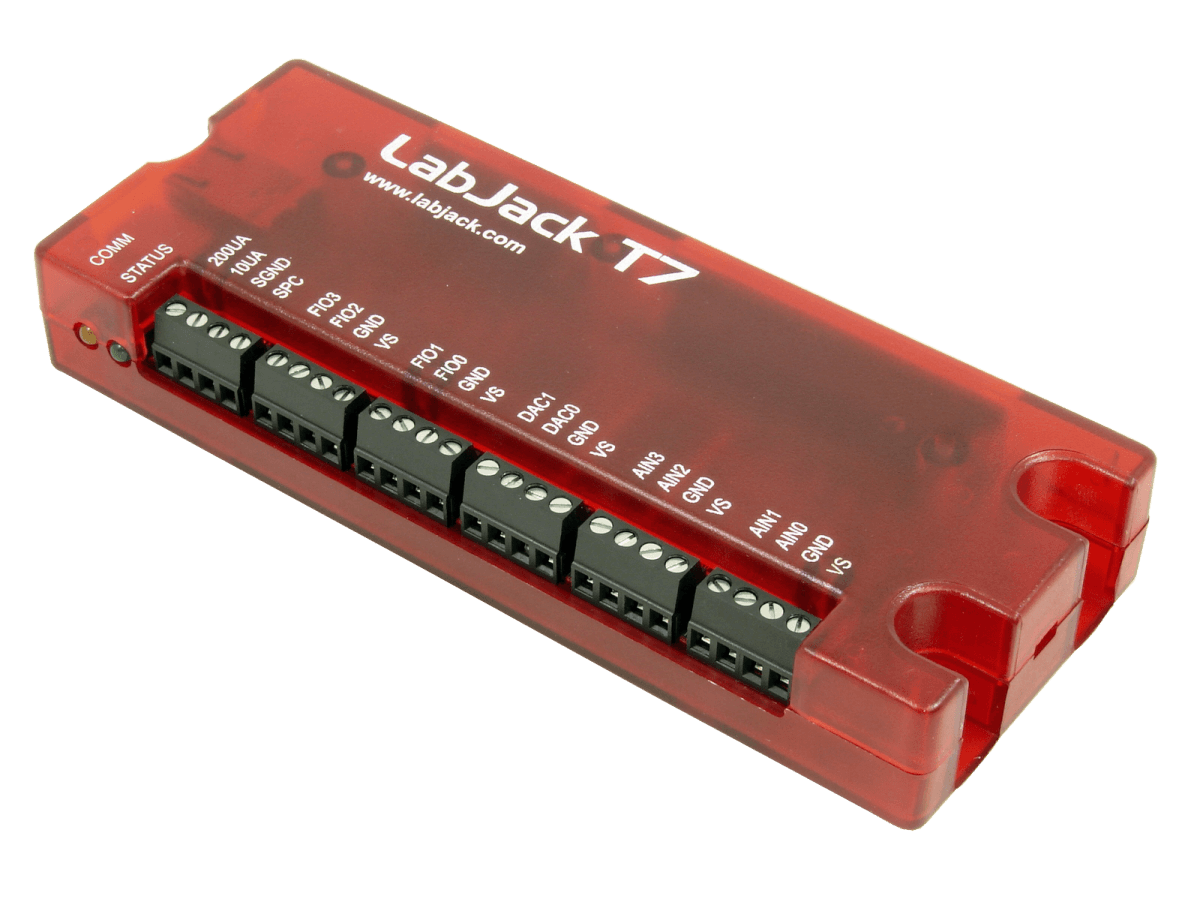
Choosing data acquisition hardware looks simple until the device arrives and the numbers don't match reality — too slow, too noisy, the wrong connector, a missing channel. Returns and re-buys are expensive in time as much as money. The patterns are remarkably consistent, though, so they're easy to dodge once you know them. Here are the mistakes we see most, and how to avoid each.
Mistake 1 — Buying by the headline number
The spec sheet shouts "100 kS/s!" or "24-bit!" and that becomes the decision. But the biggest number is rarely the relevant one. A device's top sample rate is usually a total shared across channels — "100 kS/s" across 10 channels is 10 kS/s each. And 24-bit resolution is wasted if your signal is buried in noise or your range is wrong.
Avoid it: start from your signals, not the spec. For each signal, write its range, smallest meaningful change, and fastest rate. Then match hardware to those. Our What is a USB DAQ and Phidgets vs LabJack guides give you that framework.
Mistake 2 — Confusing total vs per-channel sample rate
This deserves its own line because it bites so often. People assume the advertised rate applies to every channel at once. On most multiplexed DAQs it doesn't — the aggregate is divided among active channels.
Avoid it: decide how many channels you'll sample simultaneously, divide the device's total rate by that, and confirm the result still clears ~10× your fastest signal. If you need true simultaneous high-rate sampling, verify the device supports it explicitly.
Mistake 3 — Under-spec'ing resolution for small signals
Trying to read a few millivolts (thermocouples, load cells, shunts) on a wide ±10 V range throws away almost all your resolution and leaves you fighting noise forever.
Avoid it: for low-level signals, choose a device with high resolution and a programmable gain amplifier (PGA) so it can amplify before digitizing — like a LabJack T7's ×1–×1000 gains and its 24-bit option on the T7-Pro. Match the input range to the signal, not to the maximum.
Mistake 4 — Ignoring single-ended vs differential
Single-ended inputs are fine for clean, higher-level signals, but for low-level measurements, long cable runs, or noisy environments they pick up everything. People buy a channel-rich single-ended device, then can't get a quiet reading.
Avoid it: for small or remote signals, prioritize differential inputs (which halves usable channel count — plan for it). Pair with proper grounding and shielded cable.
Mistake 5 — Forgetting signal conditioning
Raw sensors often need conditioning the DAQ doesn't provide by default: cold-junction compensation for thermocouples, excitation for RTDs and bridges, current-to-voltage shunts for 4–20 mA loops.
Avoid it: confirm the device (or a plug-in module) handles your sensor type directly. Phidgets smart sensor modules and LabJack's analog-input extended features both read thermocouples/RTDs/bridges without a separate conditioning board.
Mistake 6 — Overlooking connectivity and software fit
A device that doesn't support your language, OS, or network model becomes a paperweight. So does one that can't feed your SCADA/HMI when you later need it to.
Avoid it: confirm library support (Python, C#, LabVIEW, MATLAB…) on your OS, and the connectivity you'll need now and soon — USB for the bench, Ethernet/WiFi and Modbus TCP if it ever joins a network or control system.
Mistake 7 — No headroom for the next project
Buying exactly the channel count you need today means re-buying when the project grows by two signals.
Avoid it: add modest channel and rate headroom, and prefer an expandable approach — a modular Phidgets VINT system you grow by adding modules, or a DAQ with spare channels. It's cheaper than a second device later. Compare options in the USB/Ethernet DAQ devices collection.
Mistake 8 — Skipping isolation and protection
Connecting a DAQ directly to noisy, high-voltage, or ground-loop-prone signals can corrupt readings or damage hardware.
Avoid it: use isolated inputs/outputs where the signal source is electrically hostile, and add fusing/power protection on control outputs. Isolation also breaks ground loops that quietly ruin precision measurements.
Mistake 9 — Assuming it'll log unattended
Many buyers expect a DAQ to record on its own, then discover it needs a host PC running the whole time.
Avoid it: if you need standalone logging, choose hardware built for it — a LabJack T7-Pro with onboard scripting and memory, or a PhidgetSBC4 hosting the system locally. Otherwise plan for a dedicated host.
Mistake 10 — Not testing before committing
The last mistake is buying a fleet based on one untested assumption.
Avoid it: prove the concept with a single unit first. Use the bundled tool (Phidgets Control Panel, LabJack Kipling) to confirm your real sensor reads correctly on your real bench before scaling up.
Quick pre-purchase checklist
- Listed every signal's range, smallest change, and fastest rate
- Checked per-channel (not total) sample rate
- Resolution + PGA suit the smallest signal
- Differential inputs where needed
- Conditioning for your sensor type is covered
- Library/OS/connectivity confirmed (incl. Modbus if relevant)
- Channel/rate headroom for the next project
- Isolation/protection where signals are hostile
- Standalone logging path decided
- Verified one unit on the real bench first
Wrap-up
DAQ regret almost always traces back to choosing by the biggest number instead of by your actual signals. Run the checklist, match the hardware to what you measure, leave a little headroom, and verify one unit before you scale. Do that and the device you buy is the device you keep.
Want a second opinion before you buy?
Send us your signal list and how the project might grow — we'll sanity-check it against this list and recommend hardware that won't need replacing in six months. Genuine products, local stock, fast delivery.
Get a pre-purchase review →