
Phidgets vs LabJack: How to Choose the Right Measurement Hardware
Both connect the physical world to your computer. They solve different problems. Here's how to pick the right one for your project — without buying twice.
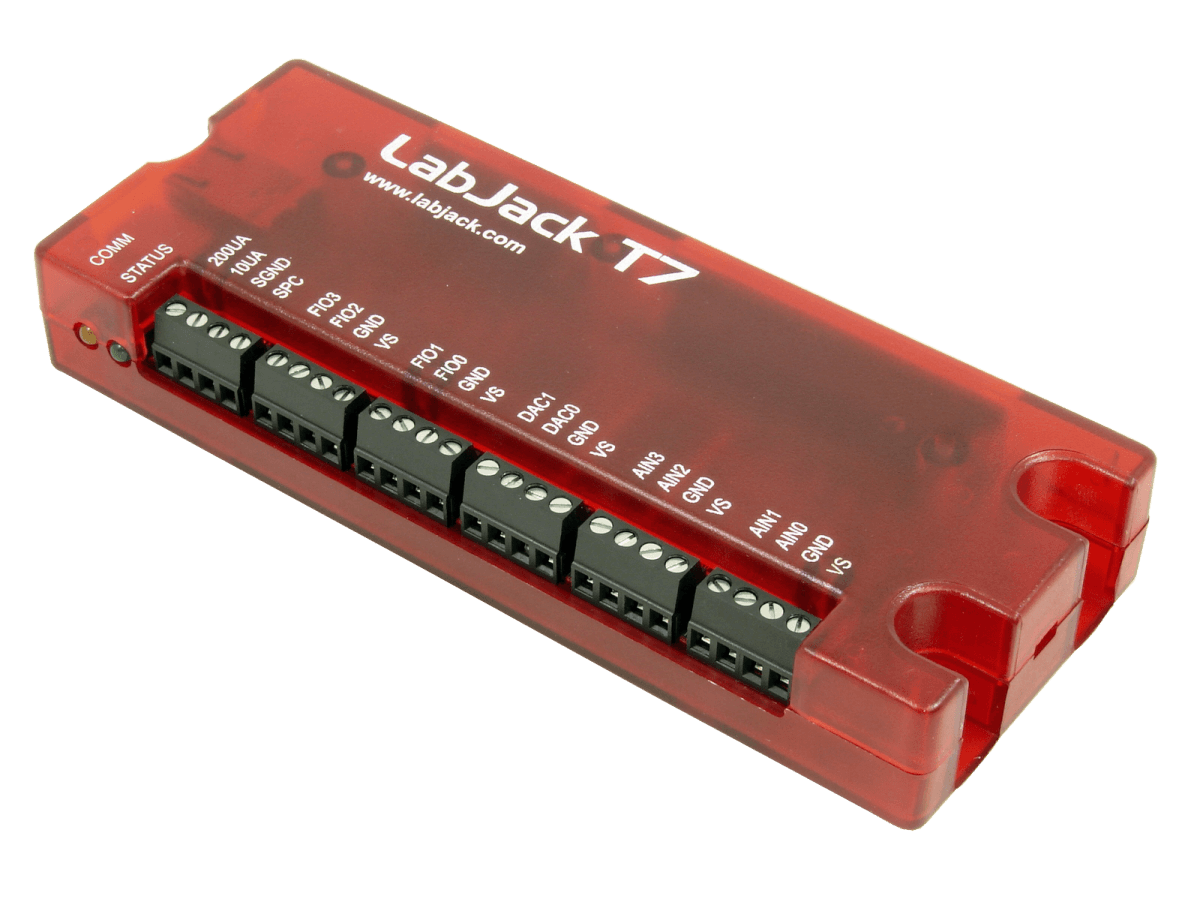
If you're building a test bench, a monitoring rig, or an automation setup, you've probably landed on the same two names: Phidgets and LabJack. They look similar from a distance — small boxes that plug into a USB port and let your software read sensors and control hardware. But under the hood they're built around different philosophies, and choosing the wrong one usually means re-buying hardware halfway through a project.
This guide breaks down the real differences, the questions that actually decide it, and which one fits common use cases.
The short answer
- Choose Phidgets when you want to assemble a system from modular, plug-and-play building blocks — sensors, relays, motor controllers, I/O — with minimal wiring and almost no electronics knowledge.
- Choose LabJack when your priority is measurement quality and flexibility on the analog side — higher resolution, faster sampling, differential inputs, and direct connection to your own sensors and signals.
Plenty of benches end up using both. But if you only buy one, the decision below will tell you which.
How each one actually works
Phidgets: a modular ecosystem
Phidgets are building blocks. At the centre sits a VINT Hub that plugs into your computer over USB (or the network). Into that hub you click smart devices over standard cables: an RTD interface, a thermocouple input, a relay board, a stepper controller, a distance sensor, and so on. Each smart device handles its own electronics and reports back in engineering units over a digital protocol.

The result is a system you grow by adding modules, not by wiring op-amps. The unified Phidget22 API works across Python, C#, Java, JavaScript, C/C++, LabVIEW and more, on Windows, macOS and Linux. If you can write a loop, you can read a sensor.
If you want the deeper architecture, our write-up on how the VINT system works covers the signal-integrity and isolation design in detail.
LabJack: a multifunction measurement instrument
A LabJack — the T4 and T7/T7-Pro are the workhorses — is a single multifunction DAQ device. Instead of clicking modules together, you wire your signals directly to its analog inputs, analog outputs and digital I/O. It's built to measure well: the T7 offers 14 analog inputs with a programmable gain amplifier (×1 to ×1000) and streaming up to roughly 100 kS/s, and the T7-Pro adds a 24-bit high-resolution ADC plus WiFi and onboard Lua scripting for standalone logging.
LabJack also speaks Modbus TCP over Ethernet, so it can drop straight into SCADA/HMI software with no driver install. It's the closer fit when you have real analog signals to capture cleanly.
The questions that actually decide it
1. Are you assembling modules, or measuring signals?
If your bill of materials reads "temperature here, a relay there, a motor over there," Phidgets' click-together approach gets you running fastest. If it reads "±10 mV bridge signal at 5 kHz with low noise," that's LabJack territory.
2. How good does the analog measurement need to be?
Phidgets analog inputs are fine for monitoring and control. But for low-level signals, high resolution, differential measurement, or faster sampling, LabJack's front-end (especially the 24-bit T7-Pro) is the stronger tool. Match the hardware to the smallest change you must detect and the fastest signal you must follow.
3. How much sample rate do you need?
For logging temperature every second, either is overkill. For capturing a waveform, a transient, or vibration, you need the higher streaming rate of a LabJack. Phidgets are paced by a data-interval model that's ideal for monitoring, not waveform capture.
4. Do you want it to run without a PC?
Standard Phidgets need a host computer (the PhidgetSBC4 is the exception — it runs Linux and hosts Phidgets locally). The LabJack T7-Pro can log and control autonomously using onboard scripting and memory. If "must run unattended in a cabinet" is a requirement, weigh those two.
5. How many of which I/O do you need?
Need lots of relays, steppers, servos and varied sensors? Phidgets scales by adding modules to hubs. Need many high-quality analog channels in one box? LabJack consolidates them.
Side-by-side
| Factor | Phidgets | LabJack (T4 / T7 / T7-Pro) |
|---|---|---|
| Core idea | Modular plug-in building blocks | Multifunction measurement instrument |
| Best at | Sensing + control, minimal wiring | High-quality analog measurement & control |
| Analog resolution | Good (per-device) | High — 16-bit, 24-bit on T7-Pro |
| Max sample rate | Monitoring-class | Up to ~100 kS/s (T7) |
| Wiring effort | Click modules together | Wire signals to terminals |
| Runs without a PC | Only with SBC4 | T7-Pro can (Lua + onboard memory) |
| Network/SCADA | Network hub / server | Modbus TCP (USB/Ethernet/WiFi) |
| Sweet spot | Test benches, automation, education, monitoring | R&D measurement, signal capture, mixed control |
Common scenarios
- University teaching lab / rapid prototyping: Phidgets — fastest path from idea to working demo. Browse Phidgets sensors and controllers.
- R&D bench capturing real analog signals: LabJack — see the full LabJack DAQ range. Our post on why LabJack is replacing box instruments explains the bench-level case.
- Production monitoring with relays, motors and a handful of sensors: Phidgets, possibly with an SBC4 for edge autonomy.
- Mixed bench: a LabJack for clean measurement plus a Phidgets VINT Hub for the relays, motors and odd sensors — a very common, very sensible combination.
Can you use both? Yes — and many do
These aren't competitors so much as complementary tools. A typical mature test bench uses a LabJack for the measurement-critical channels and Phidgets for switching, motion and auxiliary sensing. They run side by side on the same PC, each doing what it's best at.
Choosing with confidence
Don't start from the brand — start from your signals and actions. List every measurement (with its smallest change and fastest rate) and every action (switch, move, output). If the list is measurement-heavy and demanding, lean LabJack. If it's a varied mix of sensing and control you want to assemble quickly, lean Phidgets.
Still not sure? We'll help you spec it
Both Phidgets and LabJack are stocked locally and shipped fast from TestViewShop, with genuine-product warranty and engineers who use this gear daily. Tell us your signals and what you want to control, and we'll point you to the right setup — and only what you actually need.
Talk to us about your project →