
How Engineers Use Phidgets and LabJack to Build Test Benches
A modern automated test bench isn't one big instrument — it's a few smart building blocks wired around a PC. Here's the architecture engineers actually use, and the parts that make it work.
Walk into an R&D or QA lab and the test benches that get used tend to look the same: a computer, a multifunction DAQ for the measurements that matter, a handful of plug-in modules for switching and motion, and a tidy software loop tying it together. No instrument rack, no custom PCB, no firmware project. This post breaks down how engineers combine Phidgets and LabJack to build that bench — and how to plan your own.
What an automated test bench actually does
Strip away the specifics and every test bench performs the same cycle:
- Apply a condition — power the device under test (DUT), set a load, command a position, switch an input.
- Measure the response — voltage, current, temperature, force, timing.
- Decide and log — compare against limits, record the result, move to the next step.
The hardware exists to do those three things reliably and repeatably. The art is choosing parts so each job is handled by the tool best suited to it.
The standard architecture
A practical bench splits naturally into two layers, and this is exactly why so many engineers use both brands rather than forcing one to do everything:
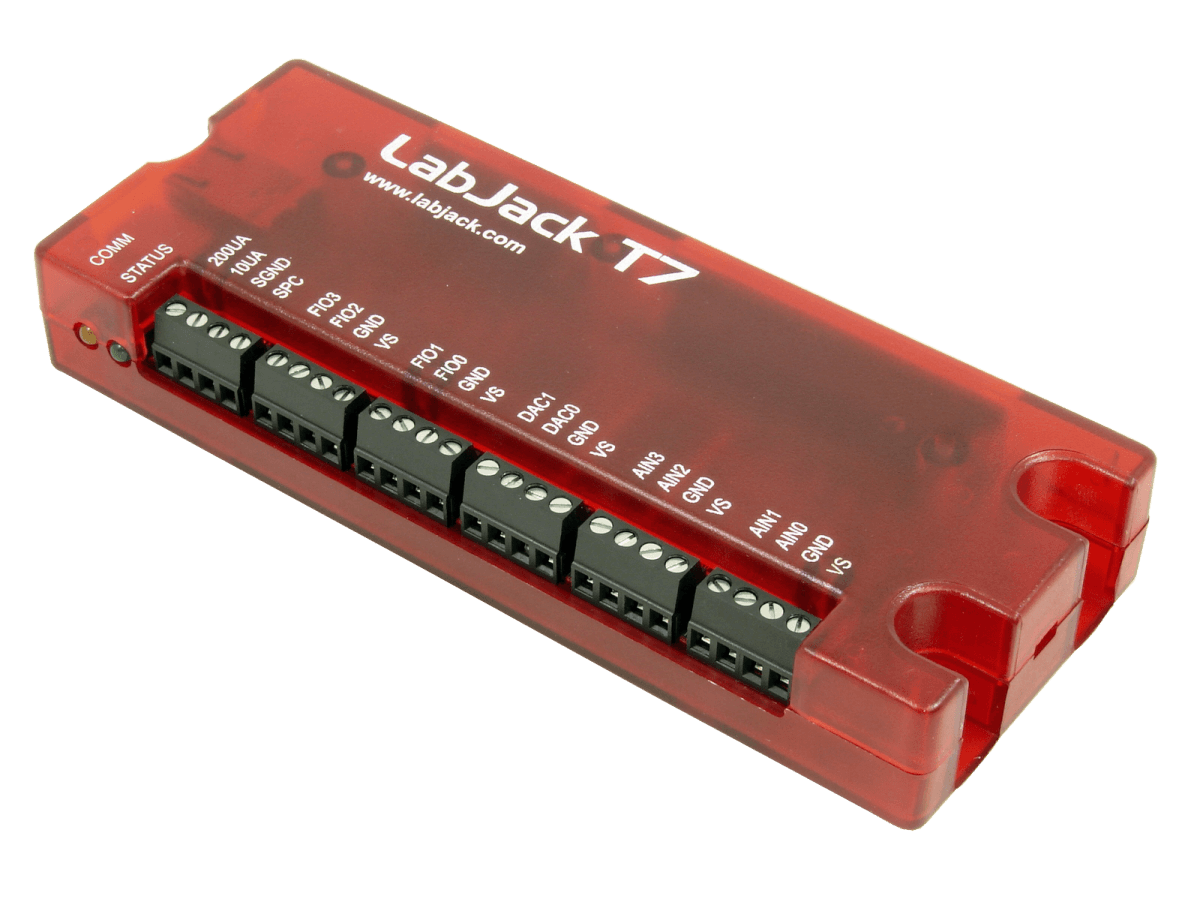
- The measurement layer — LabJack. For the signals that decide pass/fail, you want quality: high resolution, a programmable gain amplifier for small signals, differential inputs, and fast sampling. A LabJack DAQ device (T7/T7-Pro) handles the analog measurements — and via Modbus TCP it can even share data with other software on the network.
- The action layer — Phidgets. For switching power, driving motors, reading auxiliary sensors and toggling digital lines, a Phidgets VINT system is ideal: click on a relay board, a stepper controller, a temperature interface, an I/O board — each a Phidgets controller or sensor that your software commands directly.

Both layers run on the same PC, in the same script, each doing what it's best at. That division — measure with the DAQ, act with the modules — is the single most useful idea in this article.
A concrete bench: end-of-line power-supply test
Imagine a bench that verifies a small power supply before it ships:
- Power & switching: a 4× Relay Phidget (or SSR board) switches mains to the DUT and connects/disconnects load banks.
- Measurement: a LabJack T7-Pro reads output voltage (differential, high-res) and current (via a shunt), plus ripple at a higher sample rate.
- Environment: a temperature Phidget on a VINT Hub watches the DUT's case temperature during the load test.
- Sequence (software): energize → apply load → wait → measure V/I/ripple/temperature → compare to limits → log pass/fail with timestamps → disconnect → next unit.
That's a complete, repeatable functional test built entirely from stock parts — and it's representative of how these benches come together across industries.
Common test-bench building blocks
| Job on the bench | Typical part | Layer |
|---|---|---|
| High-quality V/I/ripple measurement | LabJack T7 / T7-Pro | Measure |
| Many analog channels in one box | LabJack T7 (14 AI) | Measure |
| Switch mains / loads / power-cycle DUT | Relay / SSR Phidget | Act |
| Drive a stage, fixture or actuator | Stepper / DC / servo Phidget | Act |
| Read temperature / humidity / force | Phidget sensor modules | Sense |
| Digital handshakes with the DUT | Isolated digital I/O Phidget | I/O |
| Expand ports / hubs | VINT Hub, USB hub | Infrastructure |
| Run unattended / overnight | T7-Pro onboard logging or PhidgetSBC4 | Host |
How engineers tie it together in software
The software is usually a single loop in Python, C# or LabVIEW — both ecosystems support all three. A typical step:
- Command the action layer (close a relay, move a stage).
- Settle, then read the measurement layer (DAQ channels).
- Apply pass/fail logic.
- Log the row with a timestamp.
- Advance.
Because LabJack and Phidgets each expose clean, well-documented libraries, the whole sequence is readable and maintainable — and easy to extend when the test spec changes. If you're starting from data logging, our guide on how to build a simple data logging system is the natural foundation to build a bench on top of.
Design principles that keep benches reliable
- Separate measure from act. Don't ask a switching board to do precision measurement, or a DAQ to drive a motor. Right tool, right layer.
- Isolate hostile signals. Use isolated relays, inputs and outputs where mains, motors or ground loops are in play — it protects both your data and your hardware.
- Define safe states. Decide what every output does on software crash or disconnect, and wire/configure for it.
- Design for expansion. A VINT-based action layer grows by adding modules; spare DAQ channels absorb the next requirement.
- Verify each block alone (Control Panel / Kipling) before integrating — debugging a bench is far easier when every piece is known-good.
Why engineers reach for these two
The appeal is speed and trust. You assemble a credible bench from genuine, documented modules in days, not months; you skip electronics design and firmware; and you keep measurement quality where it counts. Phidgets gives you the modular action-and-sensing layer; LabJack gives you the measurement layer. Together they cover the vast majority of test, validation and QA benches.
Wrap-up
A great test bench isn't a monolith — it's a measurement layer (LabJack) and an action layer (Phidgets) wired around a PC, with a clean software loop and disciplined safe states. Plan your bench around the three things it must do — apply, measure, decide — assign each job to the right building block, and you'll have a rig that's reliable, repeatable, and easy to extend.
Building or upgrading a test bench?
Tell us what you're testing and the measurements that decide pass/fail — we'll help you split it into a measurement layer and an action layer and spec the exact parts, with nothing wasted. Genuine Phidgets and LabJack, local stock, fast delivery, and engineers who build benches like this every week.
Plan your bench with us →